


CONTENTSSeptic Tanks
What Are They?
How Do They Work?
Design Of The TankComponents Of Sewage Treatment Systems
Maintenance
Treatment
SEPTIC TANKS
What Are They?The septic tank serves as a settling basin where solids accumulate and gradually get broken down by bacterial action.
Some of the solid waste is actually liquefied by this 'natural bacterial decomposition," however the rest of the waste accumulates in the bottom as a layer of sludge. Additionally, a small percentage of this, waste (mostly fats and oils) float to the top of the tank to form a layer of semi-solid scum.
How Do They Work?
The population living in metropolitan areas (who have never had the pleasure of maintaining a septic system, or who have never experienced waddling in their leach field, or even had the experience of pumping out their systems) simply flush their toilets and "away go troubles down the drain."
Those of us living in more rural areas have been forced to learn about the maintenance and working of the sewerage treatment facility attached to our home, "the septic system." Usually a septic tank is connected to a drainage field or seepage pit of some kind. If properly maintained, a well-designed system will last almost indefinitely. However, if it is neglected for too long a time, it can back up and clog the drainage field. This neglect can result in an expensive excavation and even a replacement of the drainpipes that could cost thousands of dollars.
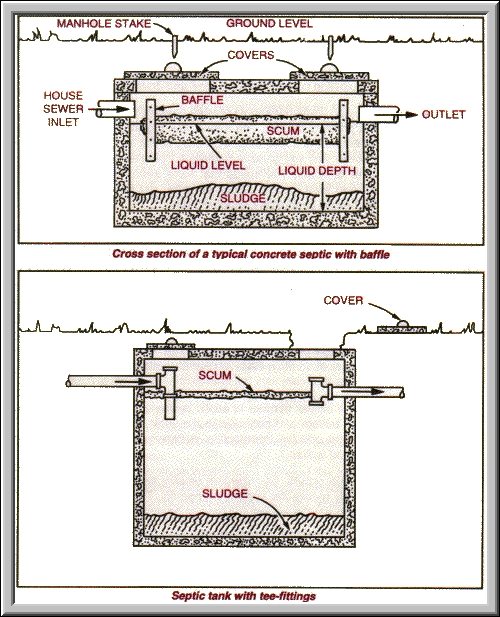
Although designs vary, most septic tanks consist of a watertight, below ground, tank that has one or two manhole covers (buried a few inches below ground) to provide access for cleaning and inspection. Effluent from the house flows into the tank through an inlet pipe near the top on one side. It flows out through a discharge or overflow pipe at the other side. The pipe may end in a large teefitting or into a baffle (wall) preventing the effluent from flowing straight across from one pipe to the other.
The incoming effluent will be diverted downward with a minimum of splashing, allowing the solids to sink to the bottom.
Outgoing effluent is drawn from several feet below the top layer of the floating waste (grease, oil, scum) so that only liquid waste or solids that have been liquefied by the BACTERIAL ACTION going on at the bottom of the septic tank (which we will come back to this point later) are discharged out into the drainage field.
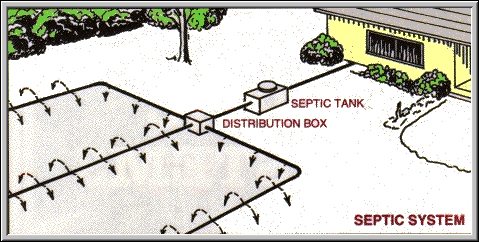
COMPONENTS OF SEWAGE TREATMENT SYSTEMSA typical household sewage treatment system consists of a house sewer, septic tank, distribution box and absorption field or seepage pit.
House Sewer - The pipeline connecting the house and drain and the septic tank.
Septic Tank - Untreated liquid household wastes (sewage) will quickly clog your absorption field if not properly treated. The septic tank provides this needed treatment. When sewage enters the septic tank, the heavy solids settle to the bottom of the tank; the lighter solids, fats and greases partially decompose and rise to the surface and form a layer of scum. The solids that have settled to the bottom are attacked by bacteria and form sludge. Septic tanks do not remove bacteria and, therefore, what is discharged cannot be considered safe.
Distribution Box - Serves to distribute the flow from the septic tank evenly to the absorption field or seepage pits. It is important that each trench or pit receive an equal
amount of flow. This prevents overloading of one part of the system.Absorption Field - A system of narrow trenches partially filled with a bed of washed gravel or crushed stone into which perforated or open joint pipe is placed. The discharge from the septic tank is distributed through these pipes into trenches and surrounding soil. The subsurface absorption field must be properly sized and constructed. While seepage pits normally require less land area to install, they should be used only where absorption fields are not suitable and well-water supplies are not endangered.
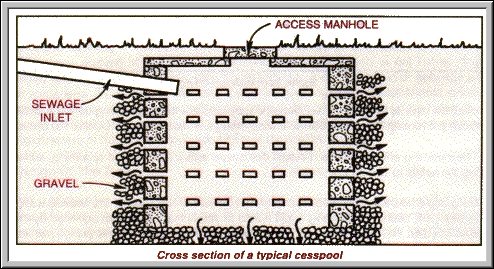
Cesspools - Work in a similar manner to septic systems. Sewage water usually seeps through the open bottom and portholes in the sides of the walls. These can also clog up with overuse and the introduction of detergents and other material which slow up the bacterial action.
When the sewage backup occurs, homeowners usually have the system pumped out. Pumping out will only relieve the system temporarily. The clogged pores in the ground remain and eventually the system will have to be pumped again and again.
Since solids will continue to build up at the bottom of the tank, it is imperative that the "septic tank be pumped out periodically." Remember, sludge is not biodegradable, if it's
not pumped out, sludge will accumulate until it overflows.The frequency of pumping out will depend primarily on the amount of wastewater that goes through the system each day. The frequency also depends on how careful you are about not throwing excess fats, rinds and other similar garbage down the drains. The more solid waste thrown in the system, the quicker the tank will fill up. Heavy flows of water also tend to make the tank fill up more quickly. That is why it is best not to use a garbage disposal in the system when you have a septic tank, and why water should not be left running indiscriminately in sinks or toilets.
TREATMENTIt is important to get the septic tank cleaned before the sludge level gets high enough so that any of the solid material at the bottom, or the semi-solid scum at the top can flow out into the drainage field. This will quickly clog the drainage pipes and the soil into which they drain.
Make certain there is live bacteria in your system at all times. The bacteria's job is to digest all organic waste matter in the system. If there is no bacteria in your system it will simply act as a holding tank for your waste. It becomes full, and natural digestion will not occur. That is when the system backs up.
Bacteria are killed off or overrun because of:
• excessive quantities of detergents, laundry waste, bleach, household chemicals, and caustic drain openers.
• garbage disposal grinds which substantially increase the accumulation of solids.
• disposal of items not biodegradable in the system (plastics etc.).
• disposal of excessive amounts of grease and fats, which are biodegradable but need particular types of bacteria to digest them.
• disposal of cigarette butts, sanitary napkins which are also biodegradable but are not readily decomposable.
• too many people using a smaller/inadequate or failing system.
If you have no bacteria in your system and you add enzymes to the system, it simply will not help and your system will still not work. Enzymes are simply a catalyst for bacteria. If there is no bacteria in your system, why use enzymes?